Felted Farmstead Pot Holders
There’s a certain rhythm to working with fiber — spinning, sorting, creating — and just as often, deciding what each part is best suited for.
On our farm, not all alpaca fiber is used in the same way.
Each year, when the alpacas are shorn, every animal receives a full haircut. But only a small portion of that fiber — what we call the “prime cut” — is used for our yarn. This comes from the blanket area of the alpaca (think: where you’d place a saddle), where the fiber is most uniform in fineness and length. It’s the best of the best, and it’s what becomes the yarn we dye and sell.
The rest still has value — it just serves a different purpose.
Fiber from areas like the neck tends to be a bit stronger and less uniform, making it ideal for something more durable. That’s where our rug yarn comes in: alpaca fiber spun thickly over a sturdy cotton core, creating a material designed to stand up to wear and use.
Rugs were the original intention.
But as with most things on a small farm, not every length ends up becoming what it was meant to be.
There are always partial skeins. Short runs. Colors that don’t quite match what came before. Pieces that are perfectly good, just… unfinished in their original purpose.
For a long time, I held onto those, too.
Because waste doesn’t sit quite right here.
These hand felted farmstead potholders are what came next.
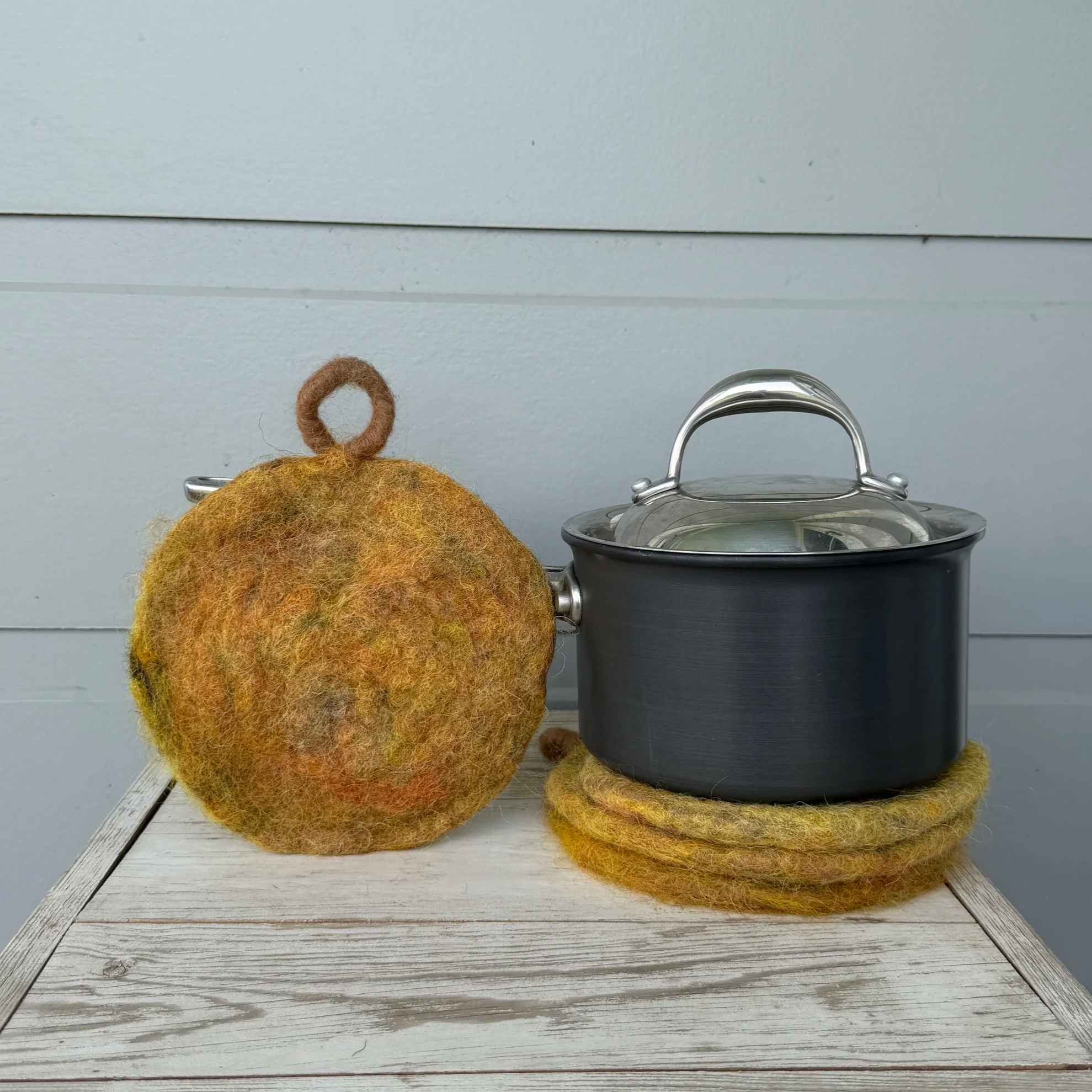
Each one is made by coiling and stitching that rug yarn into a dense, durable form — something designed to be used, not just admired. The alpaca fiber brings natural heat resistance, while the cotton core adds structure and strength, creating a piece that feels substantial in your hands and dependable in your kitchen.
No two are exactly alike. The colors shift depending on what yarn was available at the time, and each one is shaped and finished by hand — a reflection of what the farm had to offer in that moment.
They’re simple objects, but deeply practical ones.
A place to set down a hot pan. Something to protect a table. A small layer between heat and surface. The kind of item you reach for without thinking — and use every single day.
And like so much on the farm, they carry a bit of the bigger picture with them.
These pieces are part of an ongoing effort to use what we already have — to respect the materials we produce and find ways to extend their life beyond a single purpose. Instead of discarding those shorter lengths of rug yarn, they’re given a second life in a form that’s just as useful, if not more so.
Here in Walla Walla, where homegrown food, shared meals, and gathering around a table are part of the culture, it feels especially fitting to create something that lives in the kitchen — at the center of daily life.
For now, these are pieces you’ll only find in person.
I’m bringing them to the Downtown Walla Walla farmer’s market throughout the season, from May through October. During this time of year, the farm is full and busy, and shipping isn’t something I’m able to take on — which makes these market days all the more meaningful.
They’re made in small batches, shaped by what’s on hand, and once they’re gone, the next ones will be a little different.
And maybe that’s part of their charm.
They’re not mass-produced or perfectly uniform. They’re practical, durable, and made with intention — carrying forward the same values that guide the rest of the farm.
From fiber to function, they’re one more way nothing goes to waste.